

Driving Therapy Retention with AI
& Emotionally Intelligent CEA Journeys
How we helped Australia's #1 therapy platform create compassionate, psychology-led email journeys that reduce hesitation and build long-term trust through thoughtful automation and design.
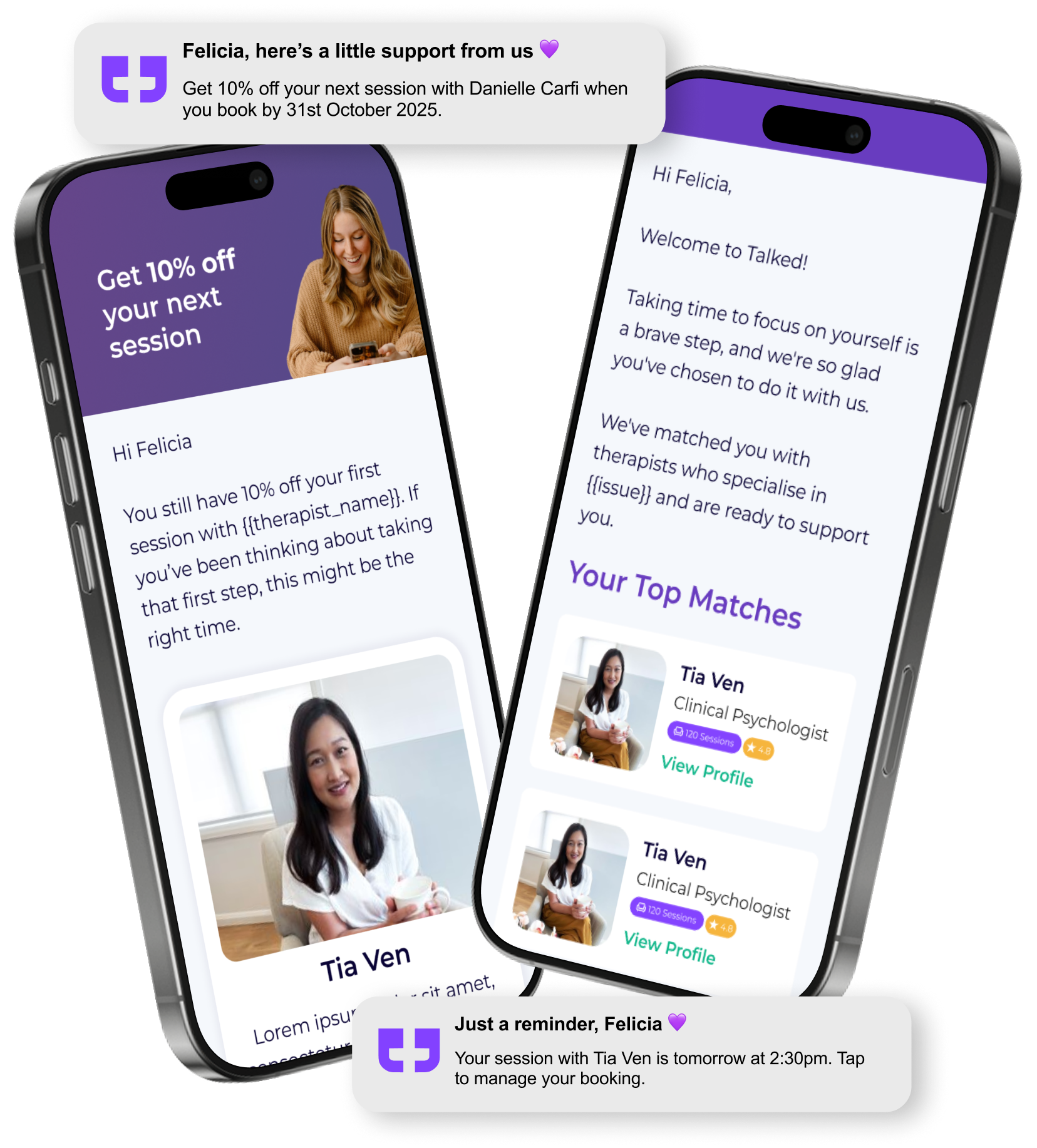

"What really stood out with GFP was how everything, the copy, the tone, even the tiniest design detail, came from a genuine understanding of our users.
They didn’t just write nice emails or design clean screens; they built communication that feels like it’s written for real people in real emotional moments.
You can tell they’ve spent time listening, to clients, to therapists, to the language people actually use when they’re struggling. That depth shows up everywhere in the work.
The end result feels
perfectly aligned with who we are as a brand, human, supportive, and stigma-free, and it’s helping us connect with users in a way that’s
both kind and effective."
-Ben Southall, Founder

“What impressed me most about GFP’s work on building out the flow was the dedication and thought that the team put into each of the email flows they created.
I could see that the team truly considered the perspective of our users and clients when drafting and creating the flows.
They helped us rebuilt an outdated process to one where the copy, visuals, and tone all reflect how our users really feel when they’re looking for support, hesitant, hopeful, and needing reassurance.
It was a genuinely collaborative process. The team came back with new insights and creative tests that surprised us in the best way. The end result feels authentic to who we are and how we want people to experience the Talked app.”
-Vincent Lau, Founder
Talked
Client
Year
2025
Background
Talked is an Australian platform making therapy more accessible, flexible, and stigma-free. As they scaled, they faced a common challenge in digital mental health: high intent signups that stalled before the first session, and users who needed more support to stay engaged long-term.
Key Goals
- Build supportive, stigma-free engagement journeys that meet users where they are emotionally.
- Boost activation and onboarding with clear, empathetic flows that lower friction and build early trust.
- Sustain long-term engagement
through email, push, and in-app touchpoints that feel validating and human.
Our Role
We built a Customer Engagement Automation (CEA) strategy that made therapy feel approachable, safe, and accessible. Each journey guided users from sign-up to ongoing support, easing hesitation, reinforcing progress, and fostering emotional safety. Psychology-led messaging and automation together helped Talked deepen trust, boost bookings, and strengthen retention.
Note: Designs have been published with the client's permission.
ARCHETYPE SEGMENTATION
Understanding Users Through Psychology
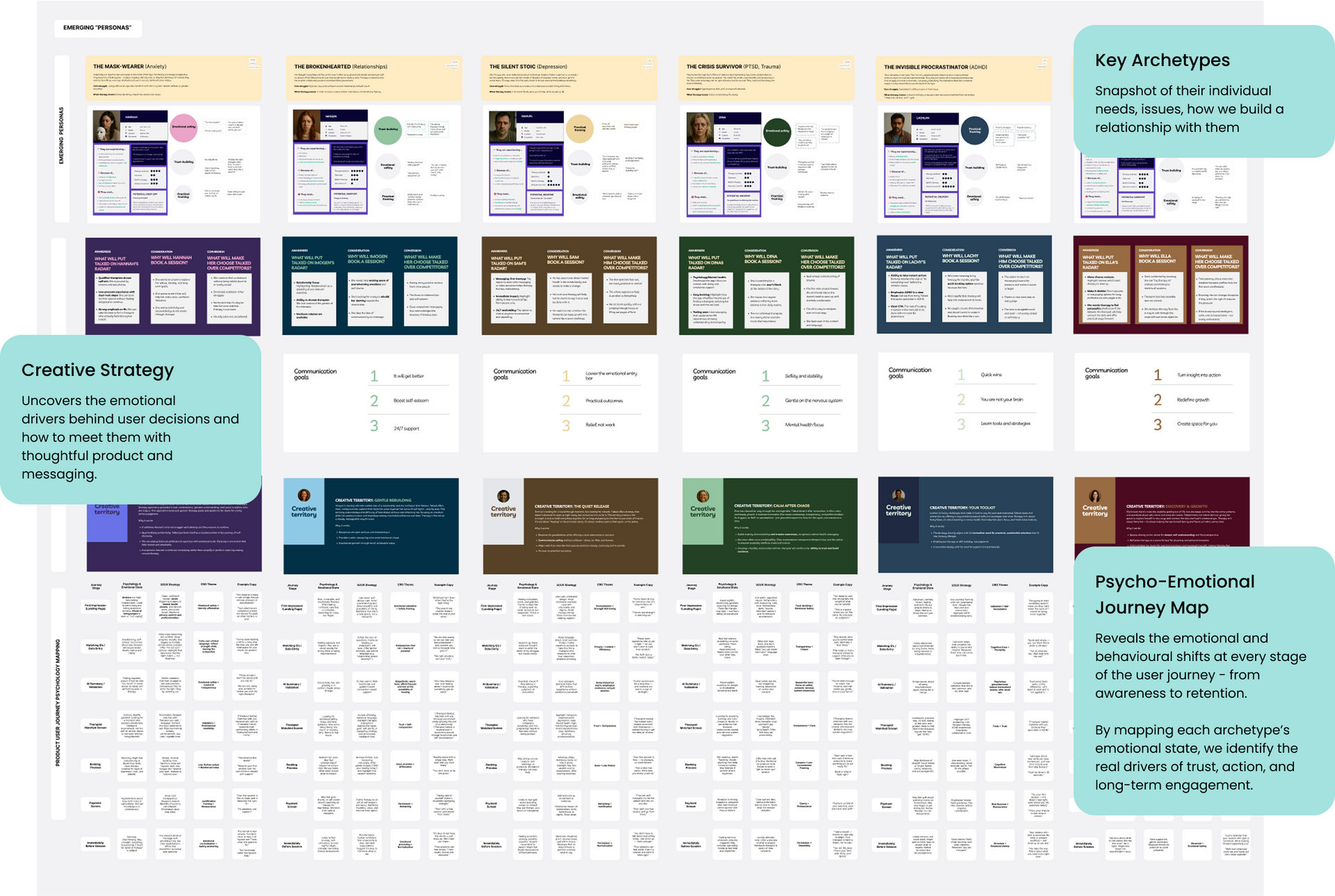
To design meaningful automations, we first needed to understand the real emotions behind therapy decisions. Through behavioural data, user interviews, and message analysis, we uncovered the fears, motivations, and triggers that shape engagement.
We then mapped six user archetypes to guide personalisation across every touchpoint. Each reflects a different emotional starting point - from seeking reassurance to ready for change - ensuring every message feels empathetic, validating, and clear.
Grounded in psychology, this foundation enabled scalable personalisation, fast iteration, and continuous AI-driven optimisation across the lifecycle.
OVERVIEW
Driving Therapy Client Activation, Bookings & Long-Term LTV
Goal:
Increase therapy bookings and long-term retention
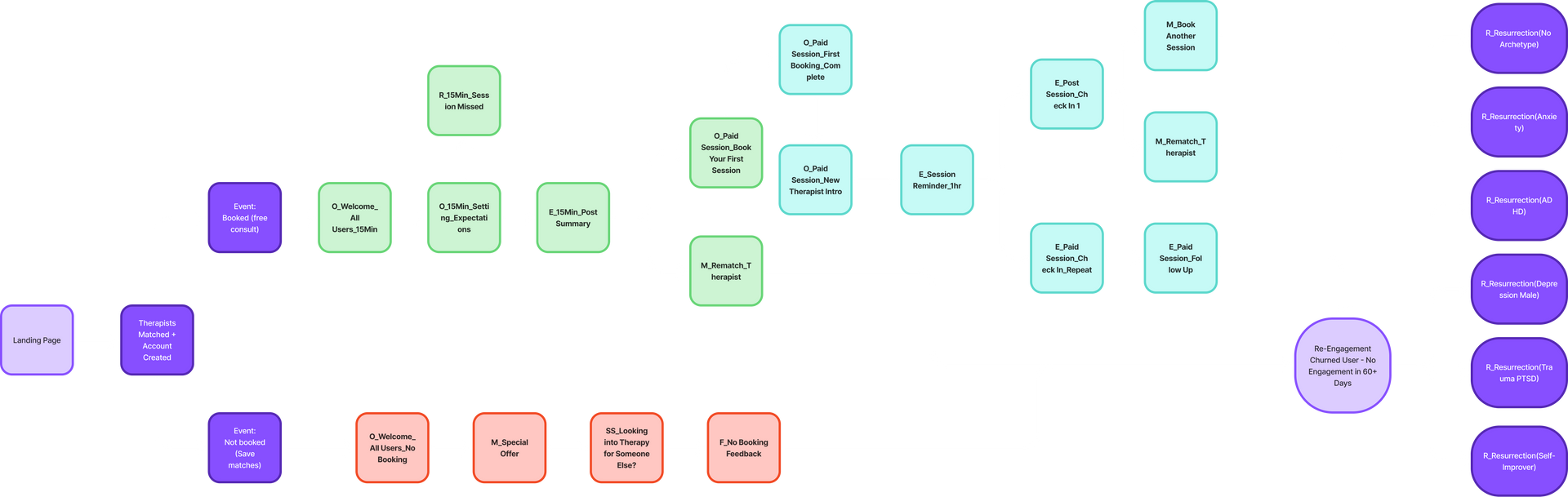
We designed a psychology-informed Customer Engagement Automation (CEA) journey for Talked - a personalised, behaviour-based system spanning email, push, and in-app touchpoints. Each pathway was tailored to different user archetypes, ensuring every message felt emotionally relevant and aligned to each user’s psycho-emotional state.
This foundational setup not only built a strong base for trust and activation but was designed for learning and evolution- capturing behavioural insights to enable fast iteration, multivariate experimentation, and continuous optimisation. From sign-up to first booking and beyond, every interaction was crafted to reduce hesitation, surface the right features, and nurture an ongoing sense of progress and connection.
CUSTOMER ENGAGEMENT AUTOMATION (CEA)
Empathy in Action: Supporting Users Through Email Journeys
Our CEA strategy via email consisted of these main approaches: Onboarding, Conversion to Monetisation, Activation & First Booking, Social Sharing, Content Engagement, Re-engagement & Retention, and Feedback Collection.
1. Onboarding
Objective: Help users discover value fast, complete setup or payment, and begin their experience.

Psychology Principles
Clarity & Cognitive Ease
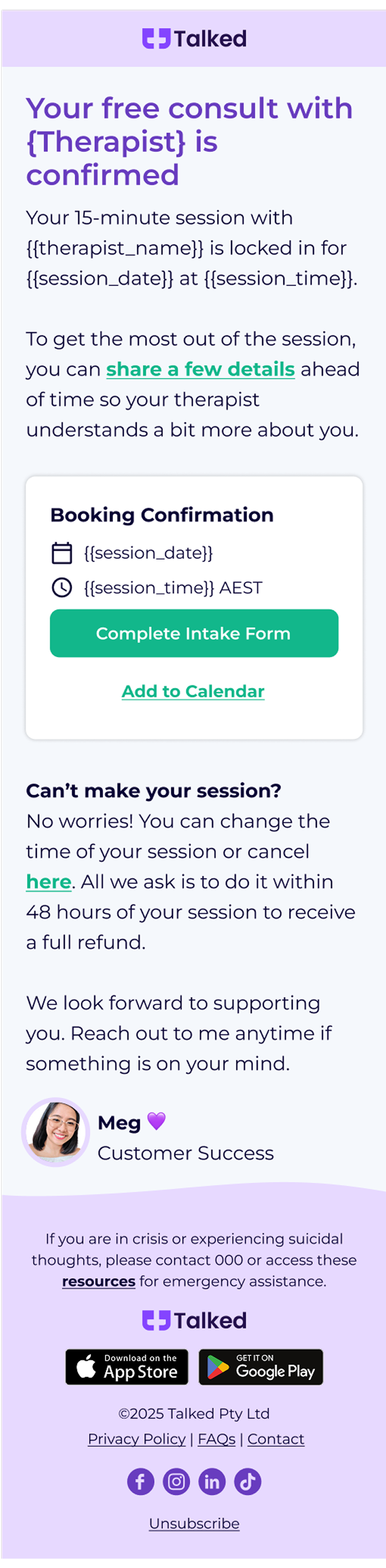
Important information such as the booking confirmation is placed in a block to provide structure and remove ambiguity which reduces cognitive load, especially under stress.
Self-Efficacy
Empowers users to prepare, giving them a sense of control → reduces uncertainty before the session.
CTA: “Share a few details” (intake form)
Emotional Validation
Reassures users they won’t be left alone and validates their choice to seek support.
“We look forward to supporting you. Reach out anytime
Psychology Principles
Personalisation
Opens up the first email with using the users name and language that makes them feel understood. This email shows that talked tailors their experience to their needs.
“We’ve matched you with therapists who specialise in (issue)”
Progressive Disclosure + Chunking
Information is presented gradually reducing user overwhelm and drop-off. Chunking allows users quickly absorb information and lower cognitive effort.
Commitment Ladder
Low-risk first step lowers barriers → encourages action without demanding a full commitment.
CTA: “Free Intro Consultation”
2. Conversion to Monetisation
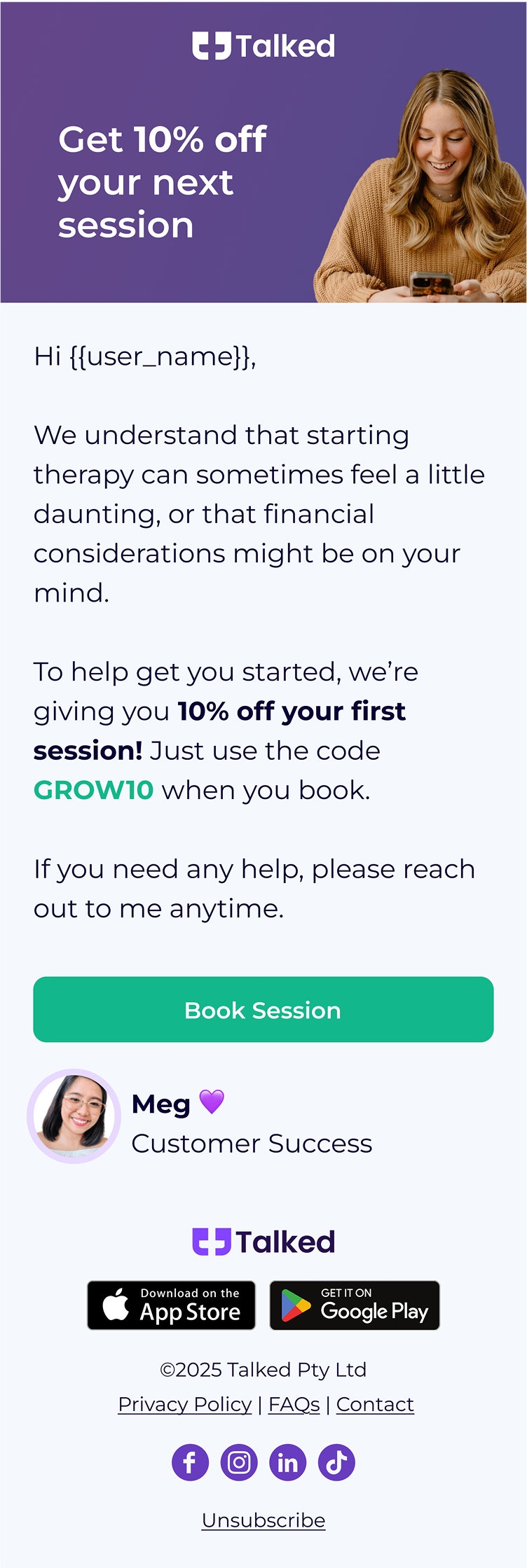
Objective: Drives users to convert through trialing the product at a discounted price
Psychology Principles
Incentivisation/Reciprocity Bias
Offering a discount feels like a gift thus triggering reciprocity and increases likelihood of taking action.
e.g. “10% off your first session!”
Commitment Nudge
Positions the discount as the gateway to an ongoing relationship.
Affirmation & Validation
Starting therapy is a hard thing to do so reaffirming that with language that reduces shame and acknowledges hesitation builds trust with new users and encourages them to book a session.
Empathetic phrasing:“We understand starting therapy can feel daunting”
3. Activation to First Booking
Objective:
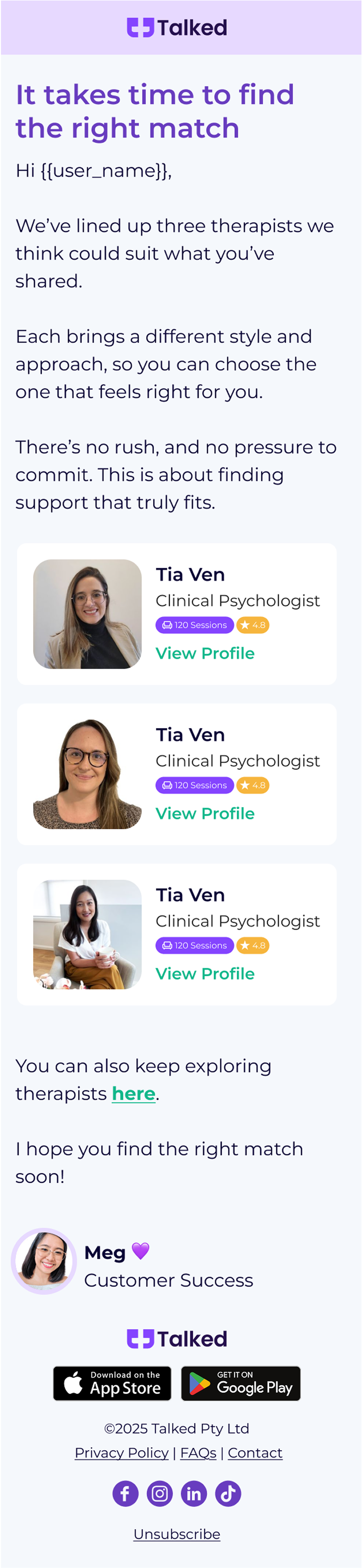
Introduces and encourages the use of core key features that drive perceived and recurring value.
Psychology Principles:
Hick's Law
Limiting the choices to the Top 3 therapists reduces cognitive load as it reduces the amount of decision making a user has to make, but still giving them choices builds trust
Pressure Reduction
Removes urgency → lowers resistance for hesitant or anxious users.
e.g -
“There’s no rush, and no pressure to commit”
Reliability/Trust Cues
Using therapist blocks and photos of their faces makes them feel real, credible and trustworthy. People respond well to seeing other humans faces, using pictures creates a more human connection.
Framing (Support-Oriented)
Positions therapy as care and alignment rather than a transactional service.
e.g. “This is about finding support that truly fits”
4. Social Sharing
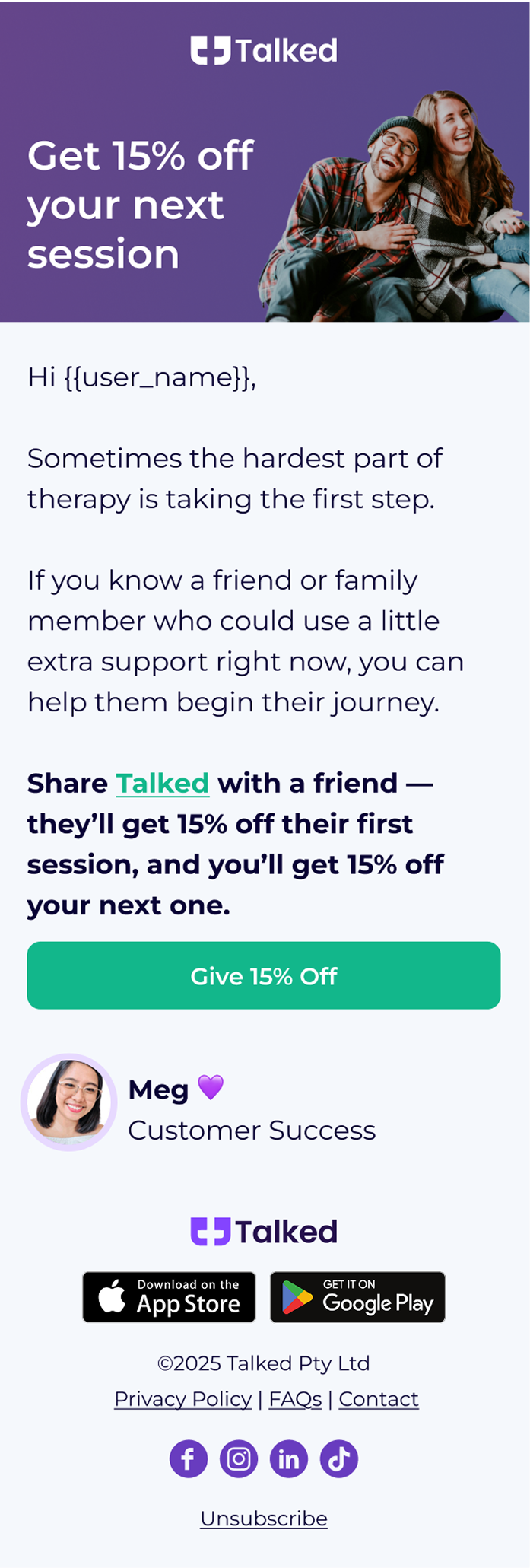
Objective: Invites new users via engaged, existing users
Psychology Principles:
Visual Anchors
Using imagery that reflects the message “share talked with a friend” allows users to feel safe and welcome. This encourages them to refer a friend as they want to share this feeling with them as well.
Normalisation
Validates common struggle → positions sharing as helping someone overcome that hurdle.
5. Education/Content Engagement
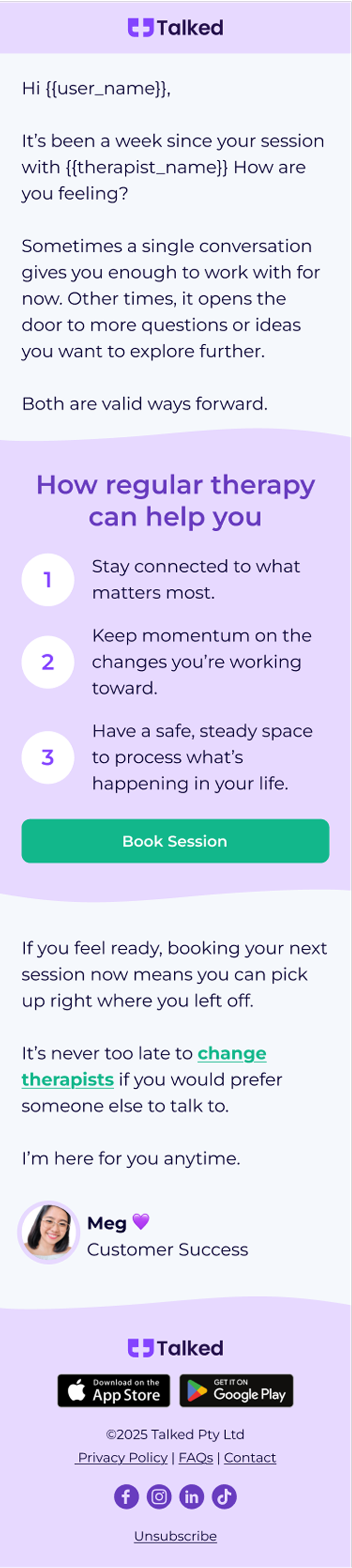
Objective: Introduces and educates users on the value of therapy
Psychology Principles:
Emotional Validation
Normalises both outcomes → removes pressure and shame if the user hasn’t booked again yet.
e.g “Sometimes a single conversation gives you enough… Other times, it opens the door to more.”
Chunking
Breaking down how therapy can help allows users to understand the benefits it can provide - - lowering cognitive load and building trust.
Loss Aversion Reduction
Removes fear of being “stuck” → reduces drop-off by reframing choice as flexible.
e.g.
“It’s never too late to change therapists if you’d prefer someone else”
6. Re- Engagement/
Retention
Objective: Invites users to re-engage in the content to get the most value as well as encourage existing users to continue using Talked.
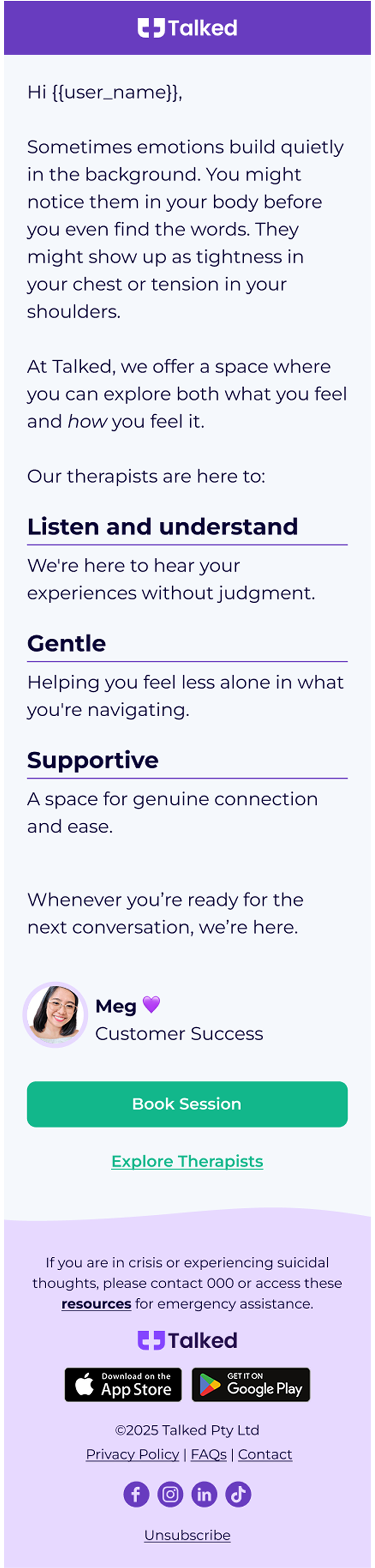
Psychology Principles:
Trust & Safety Cues
Signals non-judgment, care, and safety → combats fear of opening up.
e.g. Therapist qualities: Listen and understand, Gentle, Supportiv
Emotional Validation
Normalises subtle struggles, ensuring users don’t feel “not bad enough” for therapy
e.g.
“Sometimes emotions build quietly in the background”
7.Feedback Collection
Objective: Encourage users to give feedback based on their experience
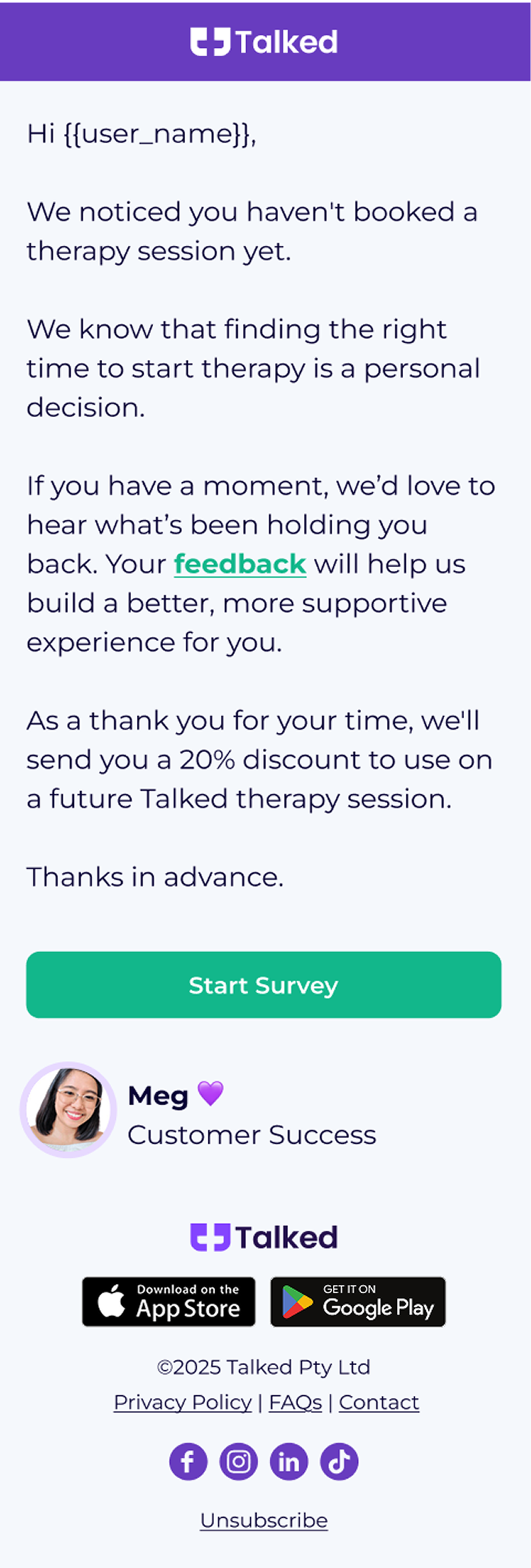
Psychology Principles:
Agency & Empowerment
Makes users feel their input matters → increases willingness to participate. Framing feedback as helping “build a better, more supportive experience”
Objection Handling
Invites honesty about barriers. Reduces resistance by surfacing unspoken doubts.
eg. “We’d love to hear what’s been holding you back.”
Ready to Grow?
Get in touch to book in a call, and make sure to check out our case studies showcasing some of our recent impact!